


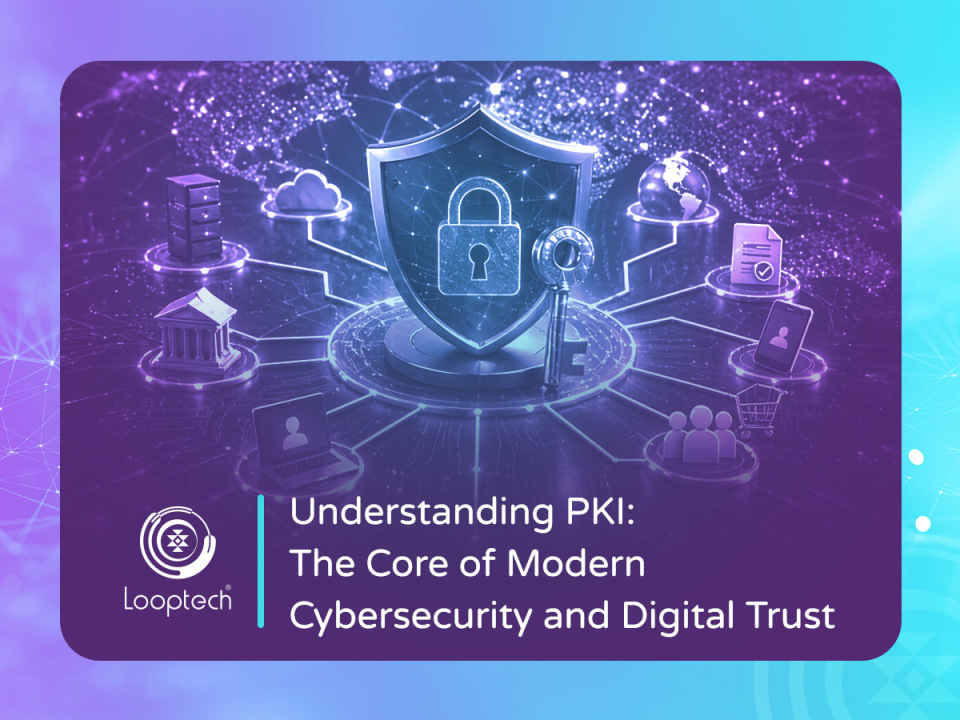
How digital certificates and public key infrastructure enable secure communication, authentication, and data protection.
As organizations accelerate digital transformation, the concept of trust has fundamentally changed.
Users, devices, applications, and APIs are constantly interacting across distributed environments, often beyond traditional network boundaries. In this landscape, trust can no longer be assumed. It must be verified, enforced, and managed.
At the center of this trust model lies Public Key Infrastructure (PKI) the foundation that enables secure communication, authentication, and data protection across modern digital environments.
PKI is often viewed as a technical component, but in reality, it is a strategic security enabler.
It allows organizations to:
From HTTPS and secure APIs to identity verification and encrypted communication, PKI underpins nearly every secure interaction in today’s IT environments.
Digital certificates are the operational layer of PKI.
They act as trusted digital identities for:
As organizations adopt cloud, microservices, and API-driven architectures, the number of certificates grows rapidly, often without centralized control.
This expansion introduces a critical challenge: Managing trust at scale.
While PKI strengthens security, poor certificate management can create significant risks.
Organizations commonly face:
In many cases, certificates are deployed faster than they are managed.
Without visibility, trust becomes fragile.
To address these challenges, organizations must evolve from basic PKI deployment to structured Certificate & Key Management (CKM).
This shift introduces critical capabilities such as:
CKM transforms PKI from a passive infrastructure into an actively managed security layer.
PKI is no longer limited to traditional use cases such as SSL/TLS. It is now deeply integrated into modern security architectures.
It plays a key role in:
As organizations modernize their infrastructure, PKI becomes a core enabler of digital trust across every layer.
The growing reliance on digital certificates introduces both opportunity and risk.
Organizations that do not modernize their PKI strategy may face:
In contrast, organizations that take a proactive approach can:
To align with modern cybersecurity requirements, organizations should focus on:
This approach ensures that PKI supports both security resilience and operational scalability.
Managing PKI at scale requires more than implementation, it requires control, visibility, and automation.
Looptech provides advanced solutions in Certificate & Key Management (CKM), enabling organizations to:
This allows organizations to maintain strong digital trust while reducing complexity and risk.
PKI is the foundation of modern cybersecurity — but its true value lies in how it is managed.
As digital environments become more complex, organizations must move beyond deploying certificates to actively managing trust.
In today’s cybersecurity landscape, trust is not static, it is continuously validated, controlled, and secured.
Organizations that invest in PKI visibility and Certificate & Key Management today will be better prepared to protect their digital future.
Contact Looptech experts to design a scalable Certificate & Key Management approach tailored to your organization.